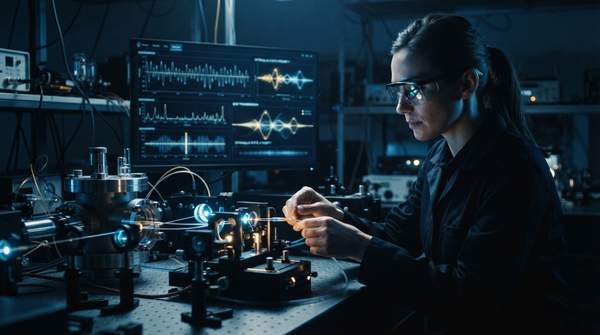
After more than five hours of meticulous measurements, physicists observed 13 full interference oscillations, accumulating roughly 80 radians of quantum phase as an atomic wave packet fell through Earth's gravity. Direct observation provides empirical evidence that gravity influences quantum systems, challenging the long-standing conceptual divide between quantum mechanics and Einstein's theory of general relativity. While these frameworks have long operated separately, this experiment unequivocally demonstrates a direct interaction. Therefore, the long-sought unified theory of quantum gravity appears closer to realization, potentially reshaping our understanding of the universe's fundamental forces.
Gravity's Quantum Touch: A First Measurement
For the first time, physicists have measured the quantum shift an object acquires by falling through Earth's gravity, observing a predicted effect on a falling quantum object (Live Science, Phys.org). The experiment directly measured a long-predicted quantum phase acquired as an atomic wave packet fell freely under gravity, while a second part remained stationary (The Brighter Side of News). Over five hours, researchers observed approximately 13 full interference oscillations, accumulating 80 radians of quantum phase (The Brighter Side of News). Unprecedented observation provides the first direct empirical evidence of gravity's influence at the quantum level, validating theoretical predictions and marking a significant experimental milestone in the quest for quantum gravity.
Einstein's Legacy and Precision Tests
The experiment achieved remarkable precision, with residual differences between numerical simulations and experimental phase at approximately 2.5% (The Brighter Side of News). High fidelity not only extends the boundaries of experimental physics but also validates theoretical models predicting quantum gravity effects, indicating their remarkable accuracy. Furthermore, researchers experimentally verified Einstein's equivalence principle on a free-falling quantum object (404 Media). While general relativity's principles have been rigorously tested, this new measurement's precision pushes the limits, confirming that Einstein's legacy holds even at quantum scales while simultaneously revealing new quantum phenomena.
Reconciling Classical and Quantum Gravity
Direct measurement of a quantum shift due to gravity means physicists can no longer treat gravity as a purely classical force when interacting with quantum systems (Live Science, Phys.org). Observation compels a fundamental re-evaluation of how we model the universe. The empirical validation of 80 radians of accumulated quantum phase with minimal residual difference (The Brighter Side of News) confirms that unifying general relativity and quantum mechanics will require incorporating entirely new quantum phenomena, not merely extending classical principles. The experiment moves the quest for quantum gravity from theoretical speculation to experimentally verifiable physics, providing the first empirical evidence that gravity itself induces quantum phenomena.
What are the biggest challenges in unifying quantum mechanics and gravity?
Unifying quantum mechanics and gravity faces challenges including the vast difference in energy scales, where quantum gravity effects become significant only at the Planck scale. Current theoretical frameworks, such as string theory and loop quantum gravity, propose different mathematical structures, but none have achieved definitive experimental validation. Reconciling these disparate approaches remains a primary hurdle for physicists.
What are the potential implications of a quantum gravity theory?
A complete theory of quantum gravity could provide insights into the universe's earliest moments, including the Big Bang singularity, and resolve paradoxes associated with black hole information. It might also offer a new perspective on the fundamental structure of space-time, suggesting it is not continuous but composed of discrete units at the Planck length. Such a theory would fundamentally alter our understanding of physical reality.
Continued experimental advances in quantum interferometry will likely further constrain theoretical models, guiding physicists toward a comprehensive theory of quantum gravity.