CFD Applications Across Key Renewable Energy Technologies
While the fundamental principles of CFD are consistent, its application is tailored to the distinct physical challenges inherent in each renewable energy technology. The engineering focus shifts from mastering aerodynamics in wind power to managing thermal transfer in solar systems or mitigating destructive forces in hydropower. This specialization allows engineers to use CFD to overcome the unique performance barriers of each energy source, pushing the boundaries of efficiency and reliability.
A comparison of how Computational Fluid Dynamics is applied to solve distinct engineering challenges across various renewable energy sectors.
| Renewable Energy Technology |
Primary Physical Problem |
Key Optimization Goal |
Phenomena Modeled via CFD |
| Wind Turbines |
Aerodynamics and airflow interaction with turbine blades and towers. |
Improve aerodynamic performance, energy capture efficiency, and structural reliability. |
CFD is used to analyze complex flow phenomena such as wind turbine wakes and the dynamic starting behavior of vertical-axis turbines. |
| Solar Collectors (Thermal/Concentrating) |
Heat transfer and fluid dynamics within the collector system. |
Enhance thermal efficiency and optimize heat absorption from solar radiation. |
Simulations model convective and radiative heat transfer to predict energy gains and losses within high-concentration solar systems. |
| Hydro and Marine Turbines |
Hydrodynamics and the interaction of water flow with turbine components. |
Increase turbine efficiency, improve structural integrity, and reduce cavitation damage. |
Models are used to analyze vortex shedding from turbine blades and the evolution cycle of cavitation clouds in water. |
| Geothermal Heat Exchangers |
Heat transfer between geothermal fluids and the exchanger system. |
Maximize heat transfer efficiency while minimizing the equipment's physical size and cost. |
CFD simulates geothermal heat transfer processes to optimize the heat exchanger's internal configuration and performance. |
Wind Energy
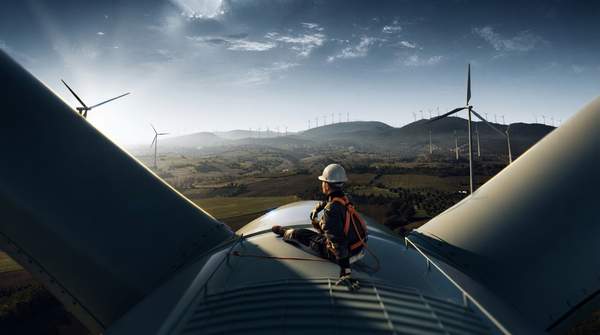
In wind energy, CFD is crucial for analyzing the aerodynamic forces that govern turbine performance. Simulations model the airflow around turbine blades to optimize their shape for maximum energy capture. A key area of study is the phenomenon of "wind turbine wakes," the turbulent, lower-energy air that flows downstream from a turbine. According to one analysis, understanding these wakes is essential for designing the layout of wind farms to ensure turbines do not interfere with each other's performance. CFD is also applied to novel designs; for example, Large Eddy Simulations were used to analyze a vertical-axis wind turbine, showing that a specific design feature improved lift generation and enhanced torque output.
Solar Thermal Energy
For solar thermal systems, the primary challenge is not aerodynamics but efficient heat transfer. CFD models are used to simulate the flow of heat-transfer fluids within solar collectors and storage tanks. These simulations analyze both convective and radiative heat transfer, which are critical for maximizing the energy absorbed from the sun while minimizing thermal losses to the environment. By modeling these processes, engineers can optimize the geometry of collectors and receivers, improve insulation, and ensure the fluid flow is managed effectively to capture and store as much thermal energy as possible.
Hydropower and Marine Energy
In hydropower and marine energy systems, which use turbines to extract energy from flowing water, CFD addresses hydrodynamic challenges. Simulations are used to analyze "vortex shedding" from turbine blades—a phenomenon that can cause vibrations and structural fatigue. Another critical issue is cavitation, the formation of vapor bubbles in low-pressure areas that collapse and cause significant damage to turbine components. Numerical predictions from CFD can model the evolution of these cavitation clouds, helping engineers design turbines that are more resistant to this destructive effect, thereby improving both efficiency and operational lifespan.
Geothermal and Bioenergy
CFD also plays a role in other renewable sectors. In geothermal energy, modeling is used to optimize the design of heat exchangers. By simulating the heat transfer processes within the system, engineers can develop configurations that maximize thermal efficiency while minimizing the physical size and investment cost of the equipment. Similarly, in bioenergy, CFD technology can simulate the complex interplay of chemical reactions, fluid flow, and heat transfer inside a reactor, which helps in determining the most effective design to optimize the efficiency of the energy conversion process.