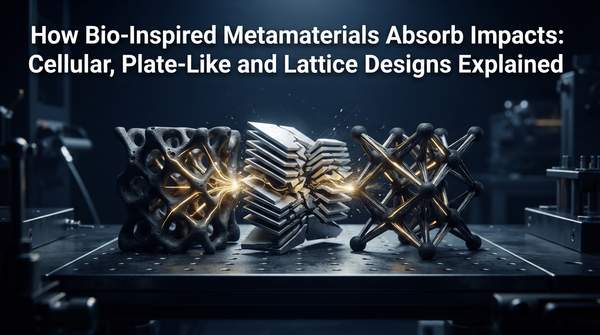
Bio-inspired metamaterials absorb impact energy not because of what they are made of, but because of how they are shaped. Their engineered microstructures borrow patterns from honeycombs, crustacean shells and crystal lattices, and translate those patterns into predictable deformation behaviour under load. Three structural families dominate impact-absorption research: cellular designs that collapse in a controlled fashion, plate-like designs that layer and twist material to resist cracking, and lattice designs whose failure sequence is engineered cell by cell. This article explains how each family works and why an engineer would choose one over another.
Cellular Structures: Mimicking Honeycombs and Bones
Cellular metamaterials take their cue from biological structures like honeycombs, foams and bone. The natural appeal of these templates is their combination of lightness and strength: a honeycomb achieves stiffness with remarkably little material, and bone achieves toughness through an internal porous architecture. Engineers copy the geometry, not the biology, arranging material into repeating cells whose walls can be tuned for a specific deformation response.
The energy-absorbing mechanism is cellular collapse. When an impact arrives, the cell walls buckle and fold in a progressive, predictable sequence, converting kinetic energy into plastic deformation of the walls themselves. Because the collapse proceeds cell by cell, the material sustains a long, roughly constant crushing force rather than a single sharp spike, which is exactly what a protective structure wants: energy dissipated over a defined deformation range rather than transmitted through to whatever sits behind it.
Research on hexagonal honeycomb and re-entrant (inward-folding) designs shows why geometry matters so much here. A study by Mohammad Mahdi Ashrafian and Rezgar Hasanzadeh in Scientific Reports evaluated lattice structures using peak force, initial stiffness, specific energy absorption and crush force efficiency as criteria, and found that a plain re-entrant lattice under axial compression performed poorly as an energy absorber, with very high peak force and low crush force efficiency. Their hierarchical combined design, by contrast, delayed wall collapse and preserved structural integrity under compression. The lesson is that the honeycomb concept alone is not sufficient; hierarchy and cell geometry determine whether collapse is efficient or destructive.