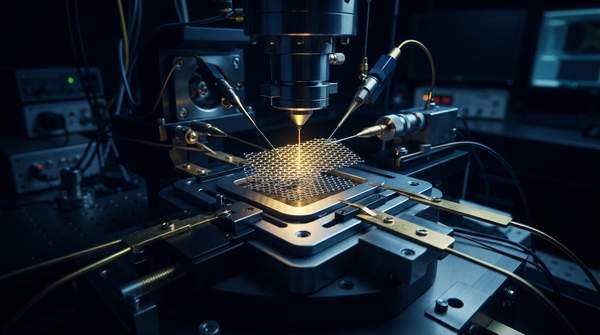
Twistronics is the control of a material's properties through the angle at which two or more layers of two-dimensional crystals are stacked and rotated relative to one another. A small twist between the layers produces a moiré superlattice — a large-scale interference pattern — that reshapes how electrons, and even photons, behave inside the material. In twisted bilayer graphene, rotating the layers to the so-called magic angle of 1.1° produces nearly flat electronic bands where interactions between electrons dominate, giving rise to superconductivity and correlated insulating states. In twisted bilayer molybdenum trioxide, the same principle steers light itself, guiding mid-infrared fields along tightly focused, diffraction-free channels.
Twistronics: How a Simple Rotation Between 2D Material Layers Rewires Electrons and Light
Twistronics leverages the geometric control of stacked 2D material layers, where a precise rotation creates moiré superlattices that fundamentally alter electron and photon behavior. This principle enables tunable electronic properties like superconductivity in graphene and light manipulation in molybdenum trioxide, opening doors for advanced quantum and optical technologies.
SA
Samuel Adebayo
November 20, 2026 · 5 min read