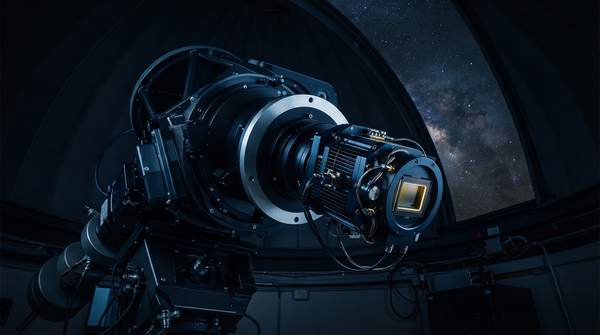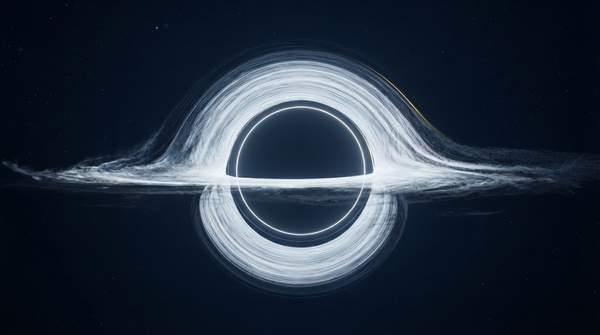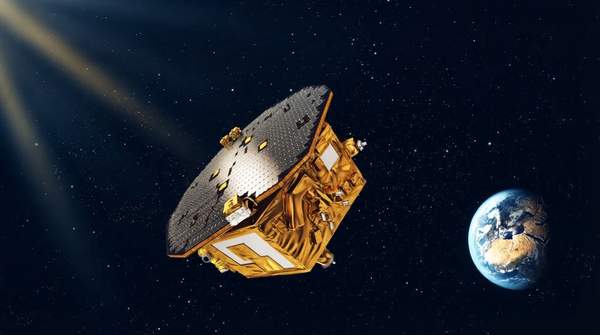
Gravitational waves ripple through spacetime across an enormous range of frequencies, and no single instrument can hear them all. The three flagship next-generation observatories—LISA, the Einstein Telescope, and Cosmic Explorer—answer that problem with radically different designs: LISA will fly in space with arms millions of kilometers long to catch low-frequency waves from supermassive black holes, while the Einstein Telescope and Cosmic Explorer will push ground-based detection to greater sensitivity for stellar-scale mergers. Their differences are not redundancies; they are complementary instruments for a multi-band view of the universe.
The Multi-Band Gravitational-Wave Universe
Gravitational-wave detectors are essentially precision interferometers: they measure tiny changes in distance caused by a passing wave. What they can detect depends overwhelmingly on their arm length and their environment. As the physics outreach portal Einstein Online explains, the space-based LISA is designed to pick up low-frequency spacetime ripples that cannot be detected at Earth's surface, while the so-called third-generation ground-based detectors will cover a frequency range similar to current instruments but with sensitivity up to 10 times higher than Advanced LIGO and Advanced Virgo in their final stage of development.
Two international projects are in preparation: the Einstein Telescope in Europe and Cosmic Explorer in the United States. Both will be much larger than current facilities, yet their designs differ significantly in some respects, and each maps its physical configuration onto a distinct slice of the gravitational-wave spectrum and a distinct set of astrophysical sources.