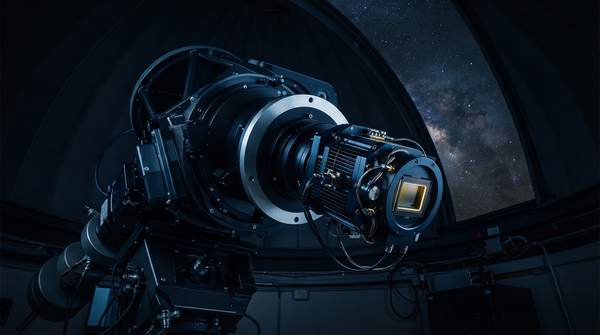
For most astronomical observations, the right detector choice comes down to one trade-off: scientific CCDs still offer the lowest-noise serial readout for faint-object, long-exposure work, while scientific CMOS (sCMOS) sensors deliver much faster parallel readout at lower cost and power—ideal for time-domain astronomy such as exoplanet transit photometry. Neither technology is universally superior. The decision depends on whether your signal is limited by readout noise or by cadence, and modern sCMOS has narrowed the noise gap enough that the two options now compete in applications once owned by CCDs.
Understanding Astronomical Detector Technologies: CCD vs. sCMOS
Charge-coupled devices (CCDs) have long been the workhorse of observational astronomy, used across visible, infrared, and ultraviolet light, as the Center for Astrophysics at Harvard & Smithsonian notes in its overview of detector technology. CMOS detectors, built on the same silicon-based electronics found in computers, arrived later: CMOS image sensors began development in the 1990s, but early versions suffered from lower dynamic range, poorer linearity, and reduced sensitivity, which confined them largely to the consumer market.
That changed in 2009, when a collaboration between Andor Technology, Fairchild Imaging (BAE Systems), and PCO Imaging introduced scientific CMOS—sCMOS—specifically to overcome the limitations that kept CMOS out of research labs. Oxford Instruments' learning centre describes the same trajectory: CMOS cameras were originally unsuitable for scientific research because of high noise and lower image quality, until a coordinated development program produced a scientific-grade variant. Today, both detector families are legitimate options for scientific-grade astronomy, and the Center for Astrophysics reports that some telescopes now use CMOS detectors because they are less expensive, consume less energy, respond faster to light, and may be better suited to higher-energy photons such as X-rays.