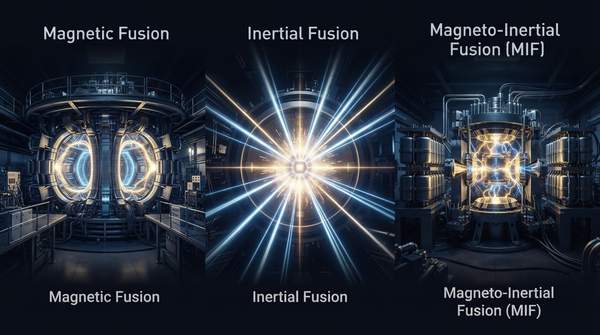
The race to controlled nuclear fusion divides into three broad strategies, according to an EPRI technology briefing that reviews the field's main confinement categories: magnetic confinement, inertial confinement, and magneto-inertial confinement. All three pursue the same goal—sustaining fusion reactions that yield more energy out than goes in—but they manage the fuel in fundamentally different ways. The crucial distinction is duration: magnetic confinement holds plasma for relatively long periods inside invisible fields, inertial confinement compresses fuel in instantaneous bursts, and magneto-inertial methods fall somewhere between the two.
The Quest for Fusion Energy: Three Paths to a Star on Earth
Fusion fuel takes the form of plasma—a gas of charged particles so hot that no physical vessel could hold it directly. EPRI's December 2023 Technology Insights briefing frames the entire landscape around how each approach "manage[s] and control[s] the fusion fuel and reactions," grouping the world's many device designs into three confinement categories. A US fusion outreach resource paints the same picture in plainer terms: one family of devices tames plasma with magnets, a second blasts tiny fuel capsules with lasers, and a third produces pulses of fusion lasting fractions of a second using currents, accelerators, and pistons.
What unites these paths is the physics problem they share. Plasma in these devices is hotter than our sun's core, the outreach material notes, so every design must keep that burning fuel away from the reactor walls while maintaining the temperatures and densities fusion requires. How each strategy solves that problem—sustained magnetic steering, instantaneous implosion, or a hybrid of both—defines its engineering character.
Magnetic Confinement Fusion: Holding Plasma with Invisible Walls
Magnetic Confinement Fusion, or MCF, rests on a basic behavior of charged particles: as EPRI's briefing explains, particles in plasma travel in spiral paths around magnetic field lines, so magnetic fields can be used to steer and confine them. MCF devices "squeeze and shape plasmas, heating them in the process, over relatively long confinement times" to generate and maintain the conditions fusion needs.
The zoo of magnetic geometries is wide. The US fusion outreach resource lists tokamaks, stellarators, spheromaks, compact tori such as the field-reversed configuration, and mirror machines among the field configurations in use. In these machines, magnetic fields control the shape and direction of the plasma, ensuring the device's walls are not damaged. The scale can be enormous: the central solenoid magnet at ITER, the report notes, will be the largest pulsed electromagnet in the world, capable of lifting a 100,000-ton aircraft carrier out of the water.
One caveat keeps MCF honest, though. Magnetic fields limit the thermal losses caused by escaping ions, but EPRI cautions that many magnetic concepts still require some form of external heating—radiofrequency energy or neutral ion beams, for instance—to maintain fusion conditions. The magnets do the steering; they do not automatically supply all the heat.
Inertial Confinement Fusion: Implosion for Instantaneous Ignition
Inertial Confinement Fusion flips the strategy entirely. Where MCF holds plasma for long durations, EPRI describes ICF as achieving confinement conditions "through physical compression"—squeezing the fuel rather than caging it. The US fusion outreach source renders the same idea vividly: targeting a grain-sized capsule of atoms with colossal lasers, sparking instantaneous bursts of energy.
The "confinement" in ICF's name comes from the fuel's own inertia. The fuel pellet is compressed and heated so rapidly that it implodes, and for a fleeting instant the pellet's own mass resists dispersal long enough for fusion to occur before the fuel flies apart. The result is a fundamentally pulsed machine: rather than one long-burning plasma, an ICF plant would fire repeated micro-explosions, each lasting a fraction of a second or less.
The landmark example is the U.S. National Ignition Facility, which EPRI identifies as the most notable demonstration of the approach. NIF drives its implosions with 192 laser beams trained on a single small target—industrial-scale optics doing the work that a tokamak assigns to superconducting magnets.
Magneto-Inertial Fusion: A Hybrid Approach
The third category is deliberately the loosest. EPRI's briefing names magneto-inertial confinement alongside magnetic and inertial methods as one of the common confinement routes for producing sustained net energy output, but the retained material describes it chiefly as a hybrid: a strategy that combines magnetic and inertial elements rather than a single defined machine geometry.
The US fusion outreach source fills in the practical texture without using the formal label. Somewhere between the long-lived plasmas held by magnets and the instantaneous bursts created by lasers, scientists have demonstrated several ways to produce fusion pulses lasting a few fractions of a second. One technique uses the self-generated magnetic field created by strong electrical current—a Z pinch—instead of external magnets. Another uses particle accelerator technology to collide bundles of plasma. These intermediate designs, the report suggests, could yield a device able to produce more energy than it consumes, though no specific design is singled out as proven.
The evidence base here is thinner than for the two parent categories: the sources support describing magneto-inertial fusion as a hybrid of magnetic and inertial confinement—using fields to curb thermal losses while compression does the rapid heating—but not a detailed account of a canonical MIF device.
Comparative Overview of Fusion Approaches
Setting the three categories side by side reveals the fundamental trade-off in fusion engineering: sustained control versus concentrated power. The table below classifies each approach by its confinement mechanism, its characteristic duration, and the devices associated with it, drawing on EPRI's category definitions and the outreach resource's device examples.
| Approach | Core Principle | Confinement Method | Typical Duration | Example Technologies |
|---|---|---|---|---|
| Magnetic Confinement Fusion (MCF) | Charged plasma particles spiral around magnetic field lines, allowing fields to steer and squeeze the fuel | Plasma held in magnetic configurations; external heating may still be needed to maintain conditions | Relatively long confinement times, sustained operation | Tokamaks, stellarators, spheromaks, field-reversed configurations, mirror machines |
| Inertial Confinement Fusion (ICF) | Fuel pellet compressed and heated so rapidly that its own inertia confines it briefly | Physical compression of a tiny target by intense energy pulses | Instantaneous, pulsed micro-bursts | Laser-driven facilities, most notably the U.S. National Ignition Facility with 192 laser beams |
| Magneto-Inertial Fusion (MIF) | Hybrid of magnetic and inertial confinement | Combines magnetic elements with compression; specific mechanisms vary by design | Pulses lasting fractions of a second—between the other two categories | Z pinch devices using self-generated fields; accelerator-driven plasma collisions |
The comparison turns on one axis: how long the fuel stays confined. MCF aims to keep a plasma burning continuously inside a magnetic cage; ICF abandons duration altogether and compresses fuel faster than it can escape; MIF occupies the middle ground, with pulsed designs that borrow magnetic and compressive tricks in varying proportions. EPRI notes that multiple approaches exist within each category as well—the diversity is not only between the three families but within them.
Navigating the Future of Fusion Energy
To understand the diverse landscape of fusion energy development, focus on the core physical principles and confinement strategies of Magnetic Confinement, Inertial Confinement, and Magneto-Inertial Fusion. The three categories are not competing answers to the same question; they are different questions about control—one asking how to hold a star steady, one asking how to ignite one in an instant, and one asking what lies between.
The measurable way to follow this field: observe ongoing research and development updates from major fusion facilities and organizations, noting which of these three fundamental approaches they are advancing. When a project announces results—whether a tokamak sustaining plasma, a laser facility compressing targets, or a pulsed hybrid device—the confinement category it belongs to will tell you which physical strategy is being tested and what kind of engineering problem remains.
Sources
- Restservice
- Approaches to Fusion — US Fusion Energy