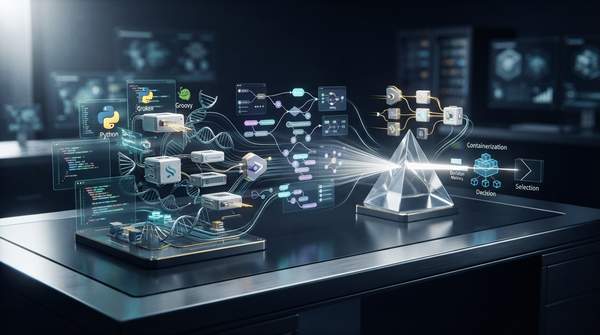
Snakemake, Nextflow, and Galaxy all solve the same problem—automating complex computational experiments so they run reproducibly and at scale—but they take three distinct architectural approaches. Snakemake and Nextflow are script-based systems, in which researchers write workflows as code in a Python-based language and a Groovy-based domain-specific language respectively, and both offer native container support. Galaxy, by contrast, is a graphical system where workflows are assembled visually and stored as definition files, making it the natural fit for teams whose members do not write code. The right choice comes down to three questions: who will build and run the workflow, what language they are comfortable with, and whether containerized execution environments are a requirement.
How Scientific Workflow Systems Provide Solutions
Traditionally, scientific analyses have been implemented in one of two ways: practitioners write scripts in languages like Python, Perl, or Bash, which demands fairly sophisticated computational skills, or they call tools manually and store intermediate results by hand, which consumes considerable time in organizing data files and managing the overall analysis process. An empirical investigation into scientific workflow system development, published on arXiv, describes both paths and their drawbacks, and notes that the field has responded with systems offering interfaces ranging from user-friendly graphical tools to script- and DSL-based platforms.
The Research Software Quality Kit maintained by the EVERSE project frames the benefit in terms of maintainability: ad hoc approaches "have been shown to be hard to maintain, hard to extend and hard to share." Workflow management systems address this by letting users describe what should be done rather than how it is done, which yields greater automation, reproducibility, and scalability. Architecturally, these systems sit atop a layered stack: research on workflow monitoring describes a resource manager layer, a workflow layer, a machine layer, and a task layer, with metrics of differing granularity and frequency retrieved from each. In practice, that means the system—not the researcher—tracks which steps have completed, which outputs exist, and where each task runs.